

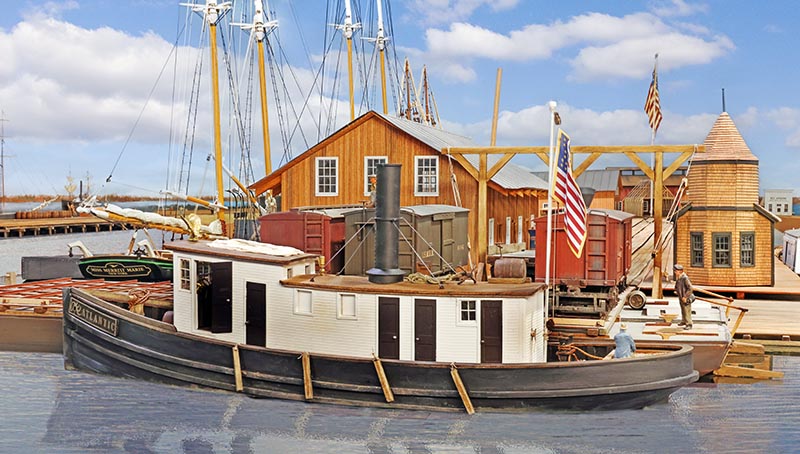
 by Bernard Kempinski, MMR/photos by the author except as noted
Building a ship model can be a daunting experience for model railroaders. One very accomplished model railroader once said to me, “I’m a model railroader, not a ship modeler,” in explaining why he did not include a ship on his extensive port-themed layout. But ships on a model railroad are not much different from any other structure, except they are set on water. I’ll cover some simplified ways to make a model of a tugboat that is as accurate and detailed as the model trains that run alongside it.
Why Ships on a Model Railroad?
Shipbuilding is perhaps the oldest model-building hobby with a long tradition. Many museums have sections devoted to ship models. Ship models grace restaurants and business as decor, and can be found on mantlepieces in homes. Ship models can be a signature feature of a waterfront model railroad. A well-done ship model will be a layout focal point. A large ship model in O scale can act as a view block between scenes. Ships can also add operational interest to a layout. A tramp freighter can accept many types of cargo, and railroad car ferries can absorb and generate cars during an operating session.
Just like the trains that populate a layout, the types of ship that are appropriate for a layout depends on the era and region being modeled. An early steam layout would have a combination of steam and sailing ships. But sailing ships can be very intricate models. The components that comprise their hulls contain complex curves in three dimensions. They can have extensive rigging for the sails and masts.
By the 20th century, commercial sailing ships had become obsolete except in a few cases. Steamships are typically not as complex models as sailing ships, but they still have their share of compound curves, specialized parts, and rigging for cargo-lifting booms and masts.
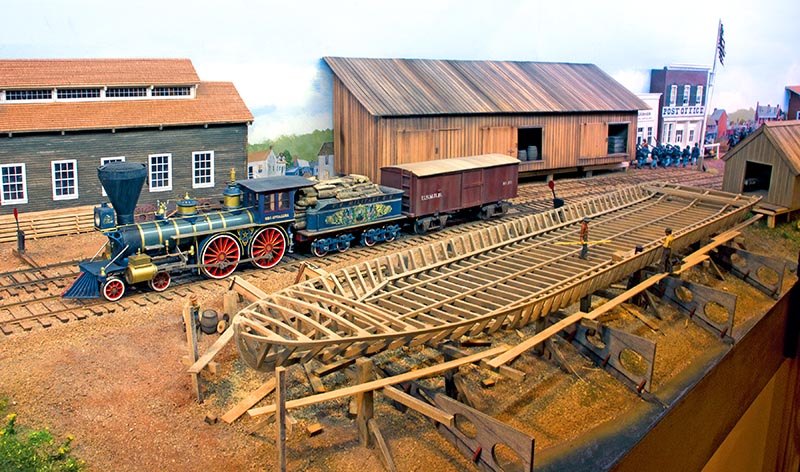
ABOVE: Plank-on-frame model of a paddle wheel steam ship under construction.
Ships in the transition from steam to diesel era and later have much simpler hull forms than earlier ships. They utilize a parallel mid-body design which creates a boxy shaped hull with streamlined portions only on the bow and stern. Their superstructures also tend to be boxy shapes as shipyards build them in sections on shore and lift them as complete pieces unto the hull. These ships can be scratch built using many of the same techniques used in land structures.
Types of Ship Models
The most common types of ship model kits are solid hull, plank-on-frame, and plank-on-bulkhead. There are also styrene and fiberglass hulls from the
radio-controlled ship hobby that might be usable as well.
Many kits have carved solid wood hulls. These kits are usually manufactured using power carving machines. They can be a bit rough. It can sometimes take as long to prepare a solid wood carved hull as it would to use a planked hull.
If you are new to ship models you should be aware that there is a difference between plank-on-frame and plank-on-bulkhead models. Plank-on-frame models have each frame from the prototype accurately modeled . While this creates an impressive model, it is much more difficult and time-consuming to build. Frequently, modelers that build plank-on-frame models leave some of the planking off to make the frames visible. No sense hiding all that work! The Royal Navy Admiralty Models are great examples of this type of modelbuilding. These were model ships built by the ship contractors of the time, probably as gifts to naval leaders they needed to impress. Since so few ships from this period survived, but several hundred models did; these are the best look we have at ship construction in the 17th and 18th centuries.
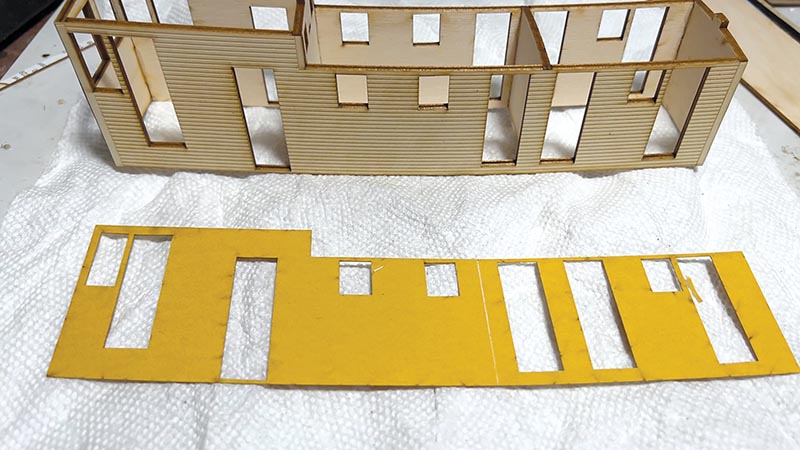
ABOVE: Superstructure core and siding.
Regardless of whether you use a kit or scratchbuild, most model railroad ships on layouts are waterline models. That is, they depict the model in the water. Thus, the portion of the hull that would be under water is omitted from the model. This simplifies the model railroad shipbuilder’s task immensely as it removes the need to build the trickiest part of the hull, the streamlined portion that is normally under and not seen.
Converting a full hull kit to waterline can be tricky. The techniques used depend on the kit construction. If you want to use a full-hull model without modification, it is sometimes possible to insert the hull into a corresponding hole in the layout’s model water surface. However, on some ship models, partially exposed rudders or propellers can make this a tricky process.
Tugboat Atlantic
I based the tugboat Atlantic on typical screw propellor tugs that were used in the American Civil War, which is the era I model. I chose the name Atlantic because it was one of the tugs that hauled the United States Military Railroad car float on my model railroad.
The first screw propellor tug was introduced into the United States in 1838. Screw propellors had many advantages over the older technology of paddle-wheel propulsion. However, at the time of the Civil War, both types of tugs could be found in operation. Wooden-hulled tugs with screw propellors remained in service well into the 20th century.
The first step to build the model was to draw the plans, as I was unable to obtain existing designs for this type of tugboat. I did find several photos of comparable tugs from the Civil War. I used those photos to draw the plans. None of the photos had perfectly orthogonal views, so I had to make corrections for perspective using Photoshop and adjusted the image using measurements of known objects like people and doors. Once I had the plan views, I made another set of drawings so that I could cut individual pieces using my band saw or laser cutter…