

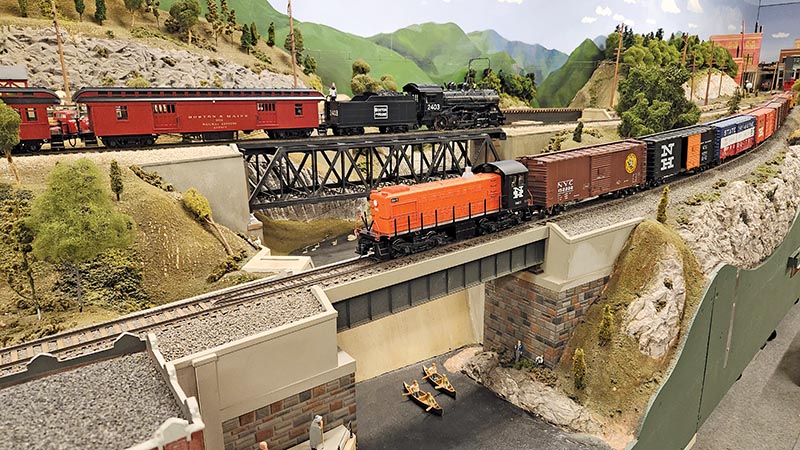
 by Jay Morris/photos as noted
The Bay State Model Railroad Museum (“BSMRM”) is a direct descendant of the Bay State Society of Model Engineers group organized in 1968. The current location in the Roslindale Village section of Boston was purchased in 1979 and has provided the club with a comfortable, permanent home. The pre-1979 group consisted of HO and O scale layouts at a rented location nearby, but with the move to this expanded location a new N scale layout was added. Of interest, some of the original BSSME members were also members of the now-defunct Massachusetts Society of Model Engineers, which was started around 1928, so our group of modelers can trace its heritage back almost 100 years.
When the current building was acquired, the group determined a fair division of the space available on the second floor between the membership in accordance with their scales. After many iterations, the O scale plan was devised by founding member the late David Waddington which accommodated both railroad and trolley enthusiasts.
There are currently about 13 active members in the O scale group. It is worth noting that many of the railroad and trolley models are assembled from kits or scratchbuilt. The large size of O scale permits easier construction of intricate trolley overhead wire systems and scratchbuilt models than do smaller scales. The railroad and trolley systems utilize digital command control (DCC). This system provides constant power on the rails or overhead (~14-17 volts) and digital communications between a controller and the microprocessor embedded in the decoder on board each locomotive and trolley car. We do retain the ability to run straight analog DC for testing purposes and visiting equipment brought by other modelers.
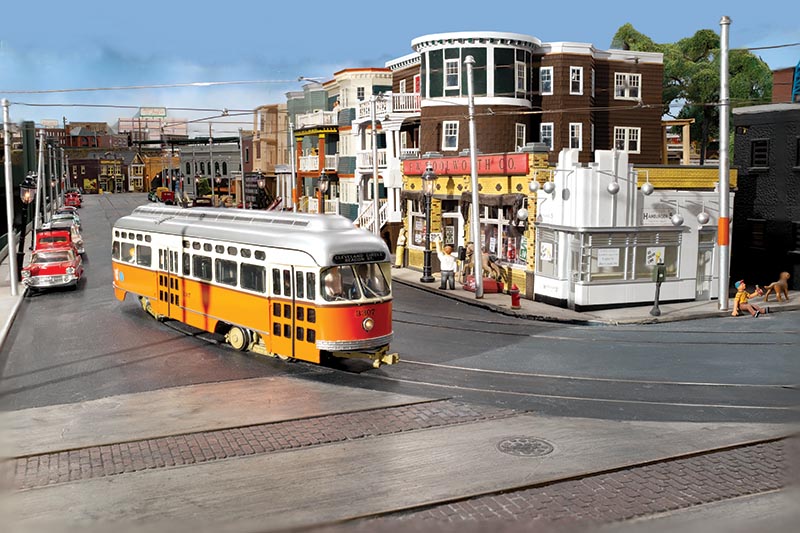
ABOVE: A postwar “picture window” PCC rolls down Washington Street toward Roslindale Square. Many of the structures are kitbashed and scratchbuilt, inspired by local architecture. Note the abandoned trolley tracks in the street. —Ken Karlewicz
The layout structure uses traditional open-grid construction in the city/urban area and L-girder supports under the linear sections through open country. The subroadbed is 1/2” plywood with Homasote roadbed, topped with individual wood ties and hand-laid rail. Some commercial assembled track (Atlas, Roco, and Micro Engineering) is used in tunnels and other hidden areas. Landforms consist of Hydrocal hardshell made of plaster cloth over cardboard strips. Hydrocal rock forms are added, and the soil areas are painted appropriate earth colors with grass, shrubs and trees added on last. Scenery work and upgrades continue.
The trolley routes are powered by fully operational overhead wire. The large amount of operating overhead has been a labor of love created and maintained over the years by members Tony Tieuli, Charles Pitts, David Waddington, and former member Ray Mitchell. Those desiring the detail and heft of large models or the excitement of streetcars running under overhead wire will often choose O scale. The freelanced layout concept centers on a city area, with inspiration taken from Roslindale and other areas around Boston. The railroad trackage includes a freight classification yard with engine service facilities, a classic downtown passenger station with platforms on the upper level, and several industrial sidings. The railroad is essentially a single-track “water wings” loop with two long passing tracks and a four-track staging yard (hidden underneath the club’s HO layout), but it gives the appearance, in places, of being double-track because of the larger loop circling the city twice, in order to return to its starting point. Railroad grades are generally limited to 2 percent.
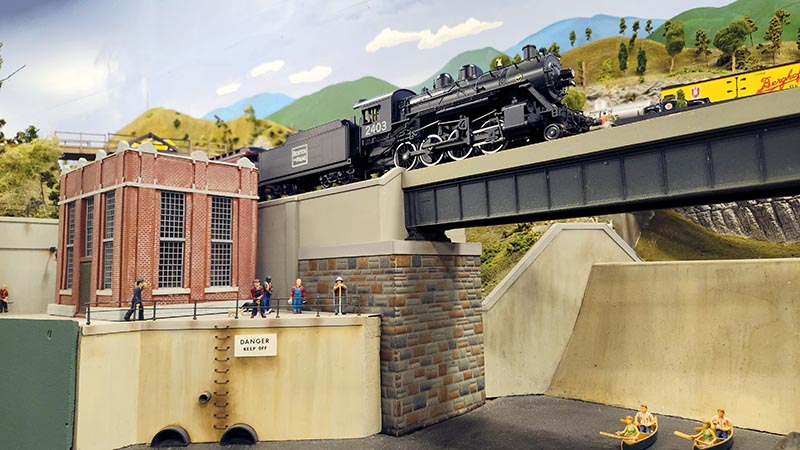
ABOVE: A Boston & Maine 2-8-0 leads a passenger train over the bridge near the small hydro-electric generating facility on the Connecticut River. —Otto M. Vondrak
The railroad’s routing is operated from a stationary control panel centrally located in an operator’s bay between the classification yard and the engine terminal. Trains and trolleys are operated via wired NCE controllers at various networked outlet ports or via wifi using TCS throttles or apps run from personal smartphones.
Minimum radius curve on the railroad is six feet, and the sharpest turnout is No. 6 with several main line turnouts being No. 8 in order to smoothly handle the largest possible locomotives and passenger equipment. Railroad main line curves are superelevated, and attention has been paid to track details including tie plates, joint bars at scale intervals, nut and bolt detail in turnout points and frogs, and other refinements more difficult to execute in the smaller scales. Many of the turnout and frog castings were designed by member David Waddington and are now produced by Right-O-Way now owned by Jay Criswell. Of particular note are the castings for the railroad’s double slip switch and the street railways in street turnouts.
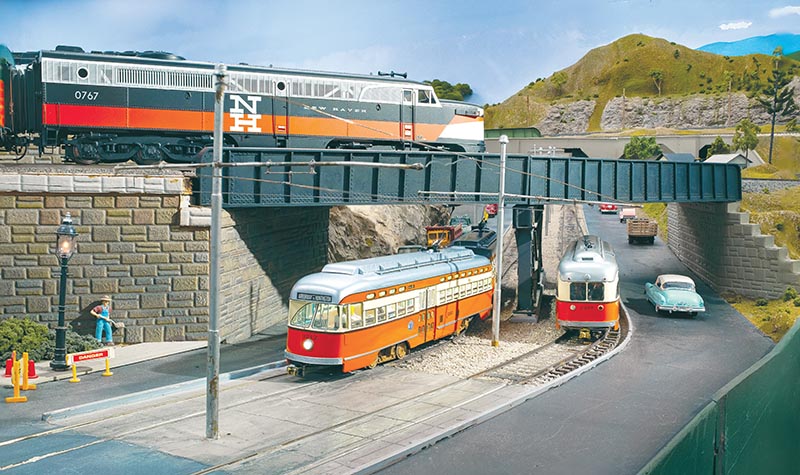
ABOVE: A New Haven Alco PA (Sunset/3rd Rail) leads a passenger train over Columbia Road, while two Boston All-Electric PCCs (St. Petersburg Tram with Q-Car Trucks) pass beneath the bridge. —Ken Karlewicz
The central city section has its street railway system and is the terminus for an interurban trolley line. The street railway layout features several routes radiating from Arborway where the car storage yard and shop are located. The car yard includes a scale model of the former Arborway trolley shelter scratchbuilt and based on the nearby structure that stood for many years in the Forest Hills section of Boston.
The urban area is loosely based on Boston’s Roslindale Square area of the 1950s. The routes vary in their construction from double track running on city street pavement to a boulevard reservation similar to Commonwealth Avenue or Beacon Street in Brighton and Brookline. A highlight of the city area is a number of classic Boston “triple-deckers” unique to the Boston area. These were researched and scratchbuilt by member Tom Landro. A local fire station was scratchbuilt by member David Barabas, who is also responsible for a great number of trees and foliage being renewed along the right of way — with the help of Tom Tello and other members…