Observations #64: Dead Rail Society

| Aug. 9, 12

I Have Seen The Future And It Is Dead!

I had the opportunity to visit an O Scale railroad that, for me, at least, portends the future of all model railroading.

Tom Thorpe [www.curvedbenchwork.com] contacted me about visiting an O Scale layout in our area that is run, in part, by radio control. I’ve been very interested in an RC for model railroading for a long time but DCC won out over cobbling up my own RC system. So, I was very interested to see what this O Scale modeler had done on his railroad.

Herb Kephart is a traction modeler and has been for a long time. During our visit he showed us the first trolley he ever built at age 13. It was built in 1948 and is made from the cardboard of a cereal box. At the time, it was unpowered, but is now fully operational.

Long-time traction modelers may not recognize Herb’s name but they might recognize Copetown Car Works in West Chester, PA, a business Herb shared with Al Lamborn, making traction body kits.

Herb’s layout is unusual for several reasons. Probably the most significant feature is that it is located in a trailer, as in tractor-trailer type trailer. The trailer was originally refrigerated so it’s heavily insulated and that makes it comfortable in both the winter and summer.

Herb’s layout is only eight feet wide but that’s not a serious issue with traction. His mainline is single track with a return loop at each end. The radius on the loops is 12”!

Herb’s layout is underwire and catenary. He told us that originally, it was all wire and all his trolleys had poles. However, poles turned out to be problematic so he switched to pantographs (that he scratchbuilds, by the way) and has been slowly converting the overhead wire to catenary.

Herb has some fancy trackwork but, because he runs under wire, his trackwork does not need to be insulated. In fact, it is all wired together as the common return, and this, I feel, was the one thing that led him to the next step.

Herb wanted to scratchbuild a small 0-4-0 steam engine. However, in order to use it on his railroad it could not draw power from the rails. That led him to radio control and battery operation. At first, Herb had to kludge up his own system from off-the-shelf RC car and boat components. They worked but not well, especially the electronic speed controls. After all, RC race cars typically are not operated at slow speed, so the slow speed control of his locomotive was less than adequate.

Battery power was also an issue. At the time, most RC systems used NiCads which have issues with charging, discharging, memory effects and energy density (i.e., run time).

So, for a time, Herb put his RC experiments away until he saw an ad online for the Stanton Radio DCC Control (or S-CAB). Herb was an early adopter of the S-CAB system. He has two scratchbuilt locomotives that are entirely radio controlled and battery operated (see Photos).


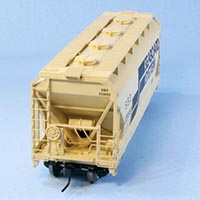
The battery technology that makes these locos work is Lithium Polymer batteries (LiPo). You can see the charger port in the center of the underarm of the boxcar. LiPo batteries have a very high energy desnity, but they also carry a bad rep because of a potential fire hazard from overcharging. But Herb says he’s had absolutely no problems with his batteries for several years. Most of the LiPo horror stories come from the RC-airplane and RC-race car world where fast charging is a typical practice to get back in the air or on the track quickly. That’s not necessary on a railroad where a slow charge is more than adequate.

We got to see the S-CAB system in actual operation. The boxcab has a coreless motor and the 0-4-0 has a small can motor. Both ran smooth as silk, silently and slowly. The S-CAB handheld looks a lot like any other DCC handheld with number keys to select your locomotive, a slider for a throttle and a direction switch. If you know how to use a DCC handheld then you know how to use an S-CAB.

The S-CAB is now sold exclusively by Northwest Short Line. When you buy into an S-CAB system you must use the S-CAB handheld with an S-CAB receiver/decoder. Herb uses the non-sound receiver that uses an NCE decoder. All of the S-CAB sound receiver/decoder combos are built on the Tsunami line of DCC decoders. NWSL also offer two different battery options: a single cell LiPo Battery Power Supply and a multi-cell LiPo battery pack. The single cell battery itself puts out 3.7 volts but through the clever use of a voltage multiplier circuit, the battery power supply outputs 12 volts DC. It also includes a built-in charger and over-voltage protection circuit. The downside is that multiplying the voltage by about 4, cuts the power available by about a factor of 4. So, while the single cell can deliver 3.7 volts at almost 1 Amp for an hour, the output of the battery power supply starts to degrade once the load current exceeds 400 ma. This battery power supply is meant for HO and N scale, not O Scale. The higher loads required by the typical O Scale locomotive means a higher rated battery is required. The user is left on their own if a higher energy battery is required. You can download the complete S-CAB User Guide from the NWSL website.

While I was very impressed with the S-CAB, I already have a significant investment in a DCC system and several decoders from different manufacturers. I really don’t want to scrap all of that and start over. So, for me, the Dead Rail System-1 from Tam Valley Depot is the answer. The DRS-1 system is composed of a transmitter and multiple receivers, each purchased separately. The DRS-1 transmitter (above left) attaches to your existing DCC command base and makes it a radio source transmitting the signals from your handheld to the DRS-1 receiver. The transmitter is similar to the type used in most portable phones and operates at 916 MHz. It has a range of about 50 feet so it should accommodate just about any home layout.  The DRS-1 receiver (above right) can be connected to any DCC decoder. Add a suitable battery and you have a system comparable to the S-CAB but a lot more flexible in terms of decoder choice and ease of programming. The downside to the DRS-1 is the choice of battery. Try searching Google for LiPo and you will be overwhelmed by the choices. I’ve at least figured out that I will need an 11.1 volt pack with a milliamp-hour rating of at least 1500, i.e., it should be able to deliver 1.5 amps for 1 hour of run time. I figure this will be plenty. I will also need an appropriate charger to go with the battery.

One other thing that Herb mentioned was the need for an ON-OFF switch. On one of his locos, he accidentally left an engine unattended with the rear headlight on. He couldn’t see it so assumed the engine was turned off. It wasn’t and the LiPo battery went to zero, which, in effect, kills it. He has rewired the locos so their headlights come on when the power is switched on. The lights are not controlled from the receiver. This way he knows if the switch is ON or OFF by glancing at the headlight. S0, I’m also going to need a power switch and a charger port.

Radio control for model railroading is not new. Articles about radio control date back to the 1940s. Don Fiehmann started the modern movement for RC control with an article in the May 1976 Railroad Model Craftsman. Don Hansen wrote about adapting airplane RC to trains in the May 1978 Model Railroader. Just last year, Ed Reutling posted several videos on YouTube (search for Ed Reutling channel) of an O Scale 44 toner running on RC and a self-contained 9V battery using off-the-shelf low cost hardware. But radio control of battery-operated DCC-equipped locomotives is what is new here.

If you are looking for more information, check out the FreeRails website or the S-Cab Yahoo! group. The Tam Valley DRS-1 System is explained in detail at their website along with prices for ordering. I’ve set up our own Dead Rail Society Forum here Click This Link.

Dead rails are the way to go! Complicated track work is a no-brainer if you don’t have to insulate the rails from each other. Yards of wire and time on your back can be saved under the layout. Imagine constructing a prototypical turnout without having to worry about frog or points polarity issues. I’m making the switch RC/DCC and you can see my progress in the Forum above. If you are interested in RC/DCC, let me know what you’re doing.

Keep Highballin’

Tags: , , ,

Category: !Joe's Projects

About Joe G.: I'm the publisher of O Scale Trains Magazine and I model the Abingdon Branch of the N&W circa 1948. I like the smaller N&W steam, like the class M 4-8-0. I'm building an O standard gauge railroad in a 14' x 28' space. I also have an interest in electronics and DCC. I do a little of everything: painting, scenery, scratchbuilding, carpentry, you name it. View author profile.

Comments (9)

Trackback URL | Comments RSS Feed

  1. up148 says:

    Great information Joe! Looks like my indecision concerning what control system to use has paid off by default. The Dead Rail System-1 sounds like the system for me. No special wiring, no shorts or problem areas on the layout. Been lurking behind the scenes about RC control for years and now it looks like its time to jump in and test the water. Thanks for the latest Observations column and this blog explaining how far RC has come.

    Butch H.

  2. lumberjack says:

    There is no real comparison between the S-Cab and The DRS-1 system. The S-Cab uses radio signals from a handheld transmitter directly to the receivers. The DRS-1 takes its commands from existing DCC cabs and sends them wirelessly to the receiver. Unless you already have a wireless cab DCC system it is not really wireless.

    Both systems are excellent with faults. The S-Cab requires you replace/buy only their receiver/decoder modules. The DRS-1 is battery powered, but there is no provision for recharging the battery from track power. The S-Cab system does.

    IMHO the best system would be one using track power with a battery back up similar to the UPS for computer systems thus avoiding interruptions from bad track contact.

    Joe, your assessment of both systems is excellent. There is one more system out there RailPro from Ring Engineering http://ringengineering.com/RailPro.htm. It is wireless with a handheld touchscreen transmitter and a receiver. Currently there is only one HO receiver available, it has sound and lights. a non sound version will be coming.

    Glenn

  3. Joe G. says:

    Glenn, I will have a much more thorough comparison of the S-CAB and DRS-1 in the upcoming Nov./Dec. issue of OST. The DRS is not really a system in that Tam Valley only provides two components of the overall system required to operate a locomotive. The user is left to provide a base station, controller, battery, connections, and a way to recharge the battery. Putting an on-board charger in a DRS install is not impossible, although it might be impractical given space requirements. The S-CAB has two big drawbacks for me. One is the battery system you mention. It can only provide 500 mA of power. That is insufficient for most all full-size O scale locomotives. For the second drawback, you’ll have to read my report in the next issue.

    My DCC base system was already wireless so the addition of the DRS components gave me a real wireless operation. I’ve looked at the Ring system but, again, it is not sufficient for an O scale locomotive at this time.

  4. lumberjack says:

    Unfortunately I am tethered, so the cost of converting truly wireless with the DRS1 is above my budget.

    What is needed is a “DRS1″ Receiver that can respond to signals from popular DCC wireless handhelds. But that entails licensing etc.

    What is also needed for O scale is a power booster/amplifier that would connect between the decoder and the motor. That way any decoder could power a larger locomotive. You could then use a track power or a larger battery.

    I will be looking forward for your comparison.

    Glenn

    What’s next? An app for your iPhone/Droid.

  5. Joe G. says:

    “What is needed is a “DRS1 Receiver that can respond to signals from popular DCC wireless handhelds. But that entails licensing etc.” That is not feasible because, generally, a handheld (wireless or otherwise) does not transmit a full DCC signal. It only sends the commands necessary for the command base to assemble the complete DCC signal to send out over the rails. There are a couple exceptions to this. The NCE ProCabR is a command station in a handheld @ $250. It also looks like the AirWire 900 throttle @ $150 sends out a full DCC signal.

  6. Q3 says:

    Joe, great article. I am ready to experiment using the items you listed in the article. I am guessing you suggested an S cab receiver/decoder because the receiver is the same as the Dead Track and the decoder is included? and this would be cheaper than buying a DT receiver and then a decoder from NCE or whoever? As for the DCC system, I see alot of O scalers using NCE to get a decoder than can handle O scale. But you say any DCC system will work? I should look for something with the features I want and not worry about how much a load it can handle? And I will not need a “booster”?

  7. Q3 says:

    Joe, I am ready to experiment using the items you listed in the article. I am guessing you suggested an S cab receiver/decoder because the receiver is the same as the Dead Track and the decoder is included? and this would be cheaper than buying a DT receiver and then a decoder from NCE or whoever? As for the DCC system, Alot of O scalers using NCE to get a decoder than can handle O scale. But you say any DCC system will work? I should look for something with the features I want (wireless) and not worry about how much a load it can handle? And I will not need a “booster”?

  8. dan3192 says:

    Joe, about 4 years ago I started to design an HO layout. I considered ways to operate it; DC, DCC, etc. I knew about RC and started to investigate ways to apply the technology to trains. After dozens of visits to hobby shops and hundreds of hours on the web gathering information, I decided to build some prototypes. To make a very long story very short, I’ve had great success building and operating 2 locomotives using a transmitter and receiver using the new 2.4 GHz frequency with DSM2 protocol and on-board battery power. My definition of “great success” is no track wiring, simple and easy operation, a smooth running engine, and the potential for basic engine sounds and switching track from the locomotive. If the reaction to my presentation at a recent NMRA meeting is any indicator of interest, I’d say radio control is the future of model railroading. My approach is the use of an open architecture, which is different than all other radio control systems. I’m confident enough to begin thinking about becoming a supplier of conversion kits using radio control and battery power. I’d be pleased to post additional comments on the subject, as I have on freerails.com, using the above user name.

  9. Joe G. says:

    Dan: Sounds like you have had great success. I would ask you to go over to the OST Modeler’s Forum and post your experiences in the Dead Rail Forums for a wider audience (http://www.oscalemag.com/wordpress/ost-forums/?mingleforumaction=viewforum&f=19.0).

    The biggest obstacle that I see to widespread adoption of RC control is the lack of a plug-n-play system. I really like the RC-DCC combination but it requires a fair bit of expertise on the user’s part to assemble the components into a working system. Many people are interested but afraid of what it takes to get it operational. An off-the-shelf system that requires minimal connections would be a boon.